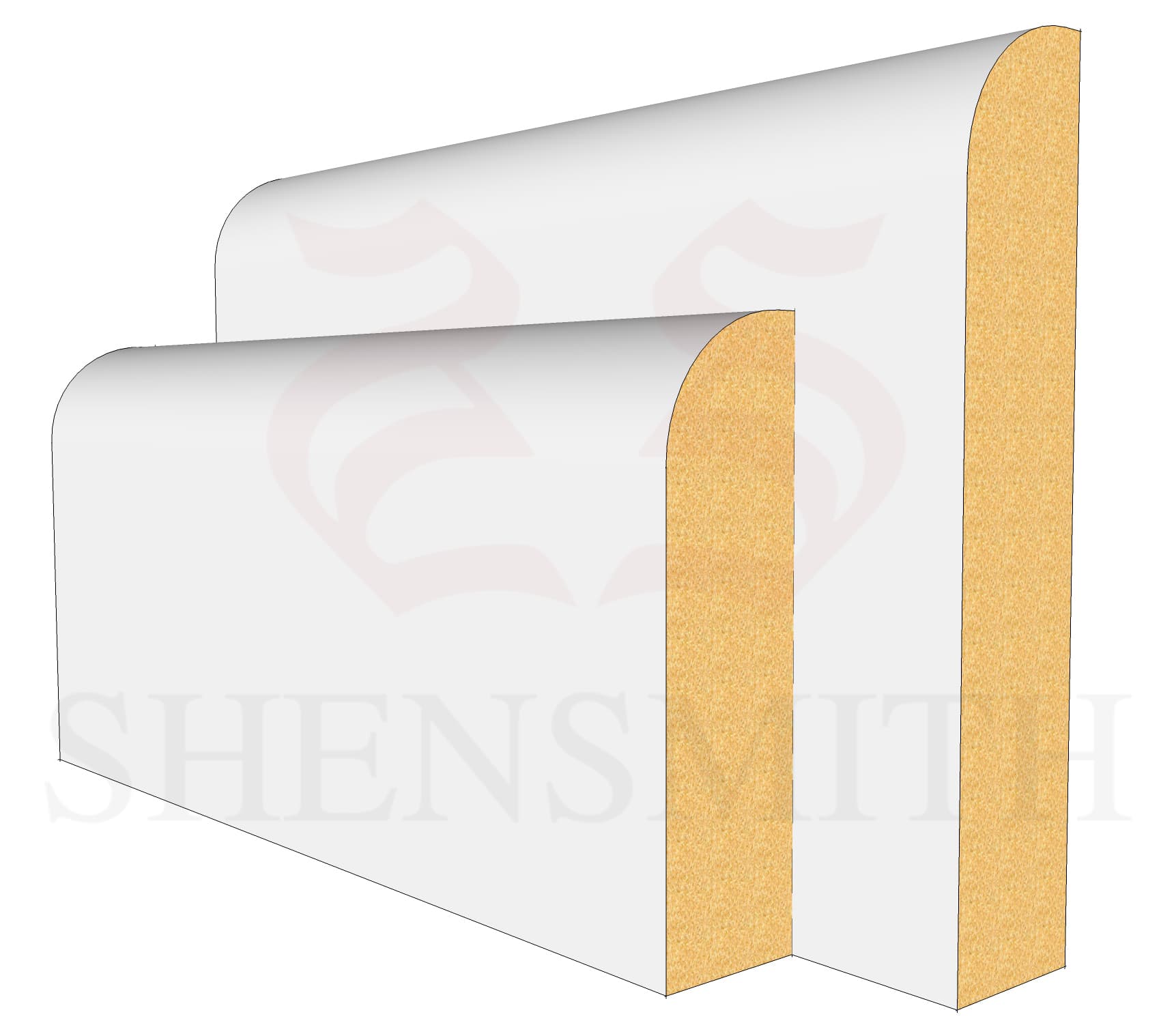
An understated door surround
Bullnose architrave gives the opening a plain face with a rounded edge. The shape is quieter than ogee or torus, allowing the proportions of the surround and the door itself to carry more of the design.
Check which edge is rounded
Architrave sections can differ in how the moulding is arranged across the width. Look at an end section to confirm the visible outer and inner edges. Pencil-round and bullnose descriptions can overlap, so a name alone will not guarantee a match.
Choose the width for the opening
Measure the clear wall space beside the frame, especially near switches and adjoining walls. A broad plain surround can be an intentional feature, but it needs enough room to terminate neatly. Check the proposed reveal around the frame at the same time.
Joining a rounded surround to skirting
Pair it with bullnose skirting for a restrained look, or use another simple profile if the shapes work together. Verify the thickness at the junction; a slight difference can be more conspicuous when both pieces have broad, plain faces.
Materials, sizes and enquiries
Confirm the material, width, thickness and lengths needed for both legs and the head. Check whether pieces are supplied bare, primed or finished, and allow for cuts. The profile directory describes design families; it does not confirm stock, delivery or a universal size.
Your questions, answered.
Can I use bullnose architrave with matching skirting?
Yes, matching profile families can create a coordinated room. Compare the actual sections, thicknesses and proportions, because a shared name does not guarantee an exact dimensional match.
What do I measure for bullnose architrave?
Measure the frame and available wall space, choose a suitable width and thickness, and plan both upright legs and the head with an allowance for your corner joints. Check each opening on site.