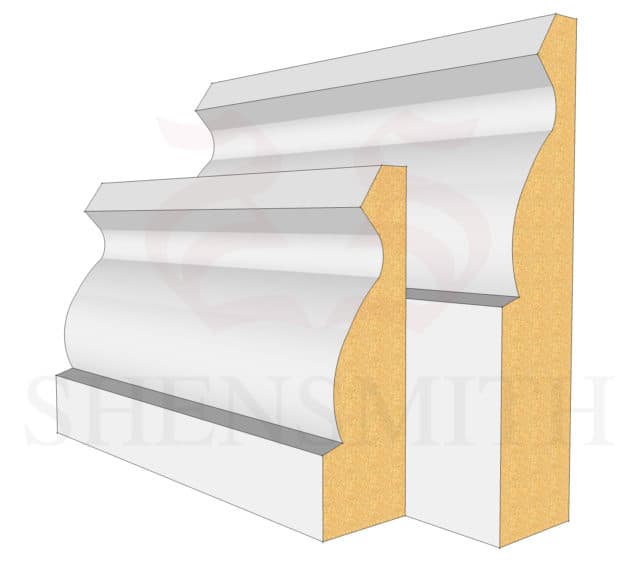
Recognising an ogee profile
The defining feature of ogee skirting is the change from an inward curve to an outward curve. It creates a stronger decorative line than a simple rounded edge. Different ogee patterns can include small flats, steps or grooves, so the name identifies a family rather than one exact cutting shape.
Ogee or torus?
Choose ogee when you want a flowing, more ornamental curve. Torus uses a rounded roll with a shoulder and generally reads as a bolder, simpler moulding. Compare samples at the height you intend to use; a catalogue close-up does not show how much plain face remains beneath the detail.
Getting the proportions right
A tall ogee board can give the moulding room to sit above a generous plain face. A shorter version may make the same detail look more prominent. Check the relationship with sockets, pipes and door surrounds, and use a full-size offcut or a paper outline against the wall.
Matching an existing ogee
Photograph the end section square-on and measure the overall height and thickness, then record where each curve and step begins. Two ogee boards of the same overall height may still have different moulding depths. Compare the actual section rather than ordering by name alone.
Materials, sizes and enquiries
MDF and timber behave differently and suit different finishing approaches. Compare the material and actual sample before choosing. Confirm the available height, thickness, length and finish for your enquiry; this profile directory does not establish current stock or a fixed product specification.
Your questions, answered.
Is ogee the same as torus?
No. Ogee is characterised by a flowing S-shaped curve; torus has a rounded roll and shoulder. Both names cover variants, so compare the actual sections.
Does ogee only suit period houses?
No. Ogee can add a decorative edge to a simpler room as well as complementing existing traditional joinery. Judge a full-size sample alongside the doors and flooring.